The AI Acceleration Curve: What It Means for Builders, Creators, and Future Focused Entrepreneurs
The pace of AI development has shifted from steady progress to something closer to a tidal surge. In the last few weeks alone, voices like Matt Wolfe, Matt Shumer, and Dario Amodei have all pointed to the same reality: the acceleration curve has steepened, and the next 1–3 years will reshape how we work, create, and build online.
For those of us building digital systems, content frameworks, and long‑term assets, this isn’t a moment to panic. It’s a moment to pay attention.
Wolfe’s latest video, Shumer’s viral article, and Amodei’s warnings all converge on a single message: the people closest to the technology are urging us to engage early, experiment boldly, and adapt faster than we’re used to.
That message aligns perfectly with the Blueprint to Passive philosophy. We don’t chase trends. We build systems. And right now, the system itself is changing.
The Shift We Can No Longer Ignore
AI is no longer a tool that simply assists with tasks. It is rapidly becoming a system that can:
- perform multi‑hour tasks autonomously
- write and debug complex software
- reason across graduate‑level material
- build the next generation of AI models
- integrate itself into workflows without human prompting
The leap from “helpful assistant” to “autonomous collaborator” is happening faster than most people expected. And the people closest to the technology, such as engineers, founders, researchers, are the ones sounding the alarm.
This is not hype. It is a signal.
What Wolfe, Shumer, and Amodei Are Actually Warning Us About
Matt Wolfe
Wolfe’s recent video frames the moment as a wake‑up call. He highlights how quickly AI has moved from basic reasoning to multi‑hour autonomous workflows, and how the next few years may reshape work more dramatically than the last decade of technology combined.
Matt Shumer
Shumer’s article reinforces the same message from an insider’s perspective. His central point is simple:
the biggest advantage anyone can have right now is being early.
Early to understand. Early to use. Early to adapt.
Dario Amodei
Amodei, one of the most respected voices in AI safety and research, warns that we are entering a period where white‑collar automation will accelerate sharply. Entry‑level knowledge work is especially vulnerable.
Together, these three voices form a coherent narrative:
AI is accelerating, and the window to position ourselves is open but not indefinitely.
The Acceleration Curve in Plain Language
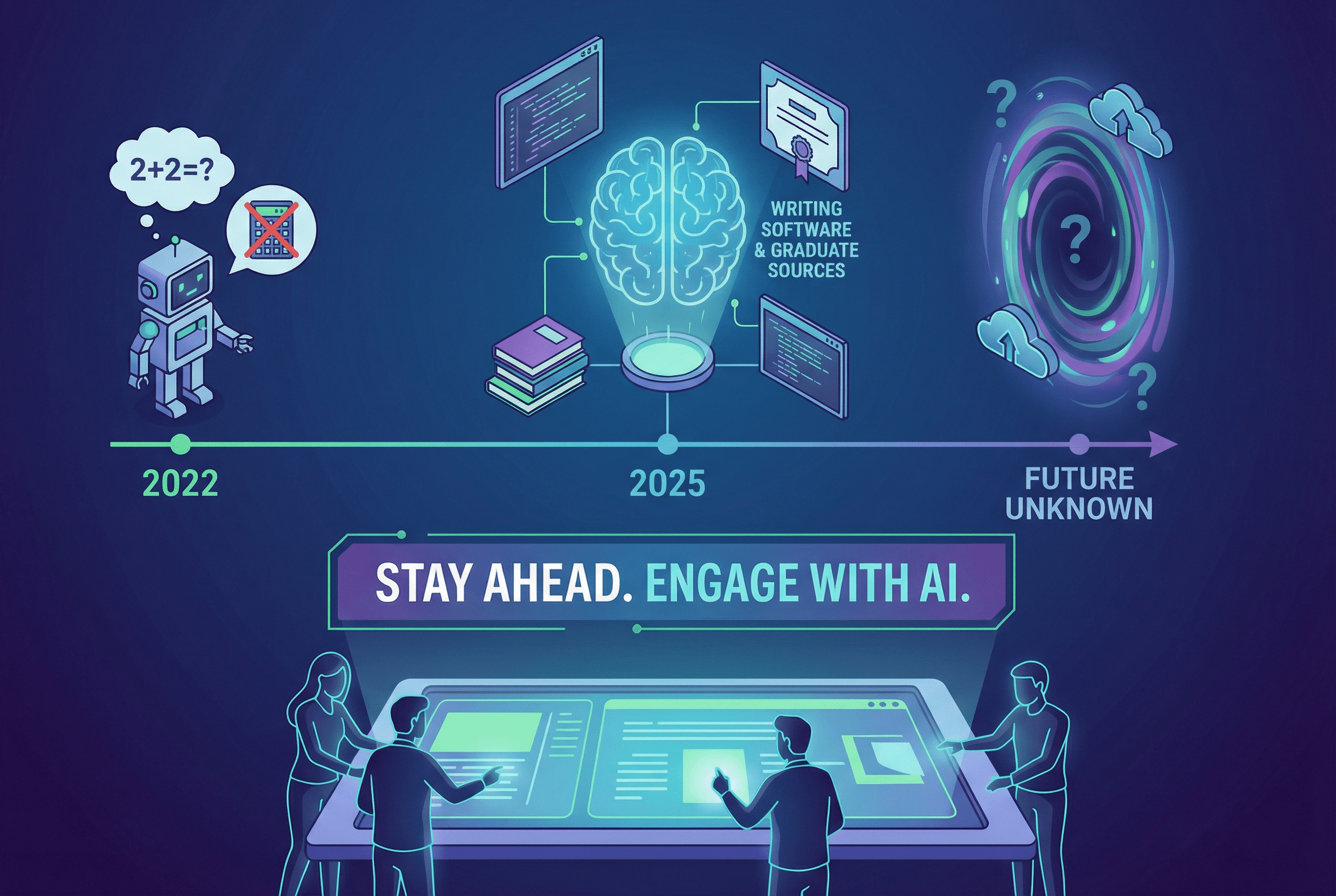
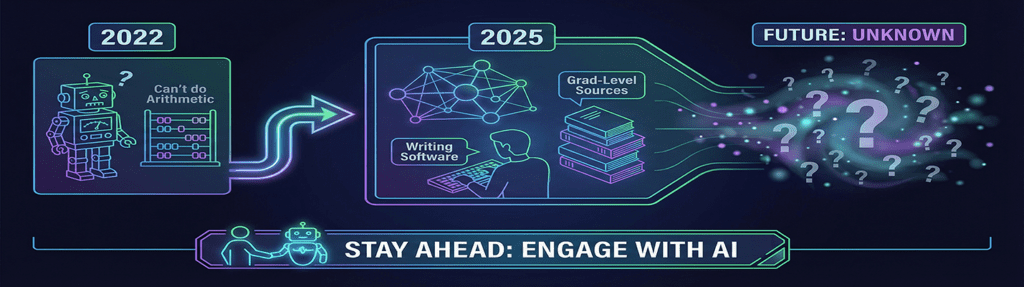
The image above illustrates the shift perfectly:
- 2022: AI struggled with basic arithmetic.
- 2025: AI writes software, reasons across advanced material, and performs multi‑hour tasks.
- Future: Unknown — but trending upward at a pace we’ve never seen.
This is not linear growth.
It is compounding capability.
And compounding curves do not give us the luxury of waiting.
Why This Matters for Anyone Building an Online Business
For creators, entrepreneurs, and system‑builders, this acceleration affects every layer of our work:
Content creation
AI can now produce high‑quality drafts, outlines, and research in minutes. The advantage goes to those who learn to guide it, refine it, and integrate it into a repeatable workflow.
SEO and discoverability
Search engines are shifting toward semantic understanding and AI‑generated summaries. Structure matters more than ever. Clear hierarchy, modular components, and consistent patterns will outperform ad‑hoc content.
Automation and systems
Tasks that once required multiple tools or manual steps can now be orchestrated by a single AI agent. This changes how we design workflows and where we invest our time.
Skill stacking
The value is no longer in doing everything manually.
The value is in knowing what to build, how to structure it, and how to leverage AI to scale it.
Early adoption advantage
Those who engage now will build the systems others rely on later.
The Architect’s Mindset: How We Adapt
Blueprint to Passive is built on the idea that we are architects of our digital future. In a period of rapid change, that mindset becomes even more important.
Here is a simple adaptation framework:
Understand
Stay informed through trusted voices.
Interpret signals, not noise.
Experiment
Test the tools.
Break things.
See what AI can do today not what it could do last year.
Integrate
Fold AI into your workflows.
Use it to build components, not just content.
Iterate
Refine your systems as the tools evolve.
Expect change and design for flexibility.
Teach
Share what you learn.
Those who teach become leaders in the new landscape.
Practical First Steps for Builders and Creators
Here are actionable steps you can take today:
- Use AI to build modular components for your site (CTAs, summaries, templates).
- Document your workflows so you can improve them over time.
- Focus on semantic structure such as headings, hierarchy, clarity.
- Use AI to generate variations, tests, and refinements.
- Start small, but start now.
- Treat AI as a collaborator, not a shortcut.
The goal is not to automate everything.
The goal is to build systems that scale with you.
The Future Isn’t Scary When You’re Building It
The acceleration curve can feel overwhelming, but it doesn’t have to be. When we approach it with curiosity, structure, and a willingness to adapt, it becomes an opportunity rather than a threat.
The next few years will reshape how we work online.
Those who engage early will shape that future.
Those who wait will be shaped by it.
Blueprint to Passive exists to help you stay on the right side of that curve.
One practical example of this philosophy in action is the Wealthy Affiliate platform, which has been steadily integrating AI tools into everyday workflows.
How Wealthy Affiliate Supports Early Engagement with AI
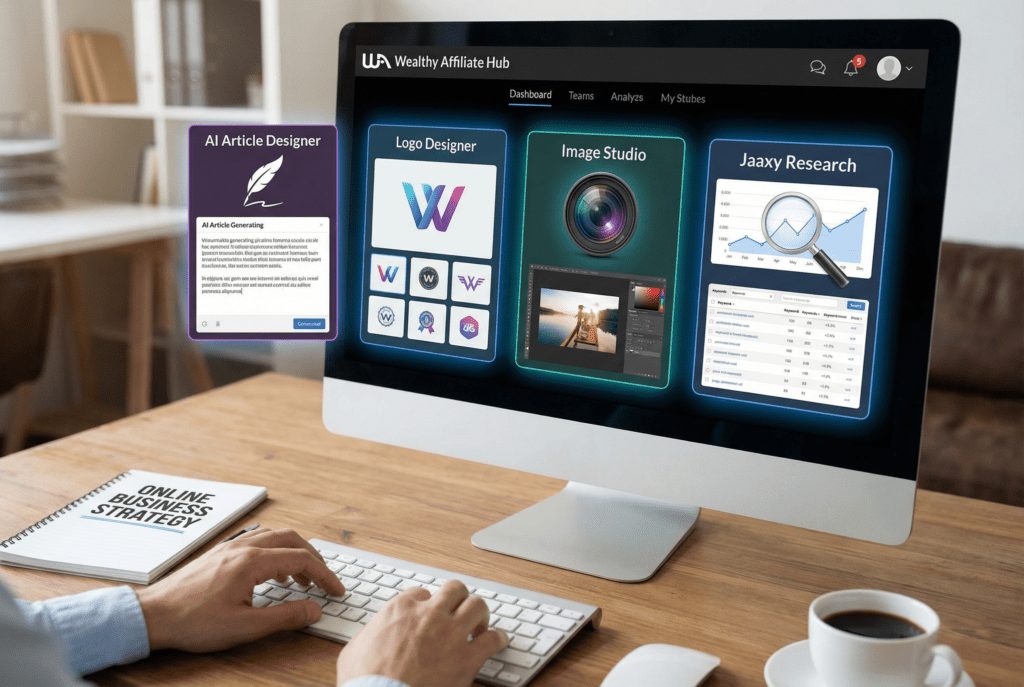
One of the clearest ways to stay ahead of the AI acceleration curve is to work with tools that help you experiment, create, and iterate quickly. Wealthy Affiliate has been steadily integrating AI into its platform in ways that align closely with the philosophy outlined in this article.
WA’s AI‑powered tools are not designed to replace creators. They exist to help you move faster, test ideas, and build with confidence — exactly the kind of early engagement Matt Wolfe and Matt Shumer encourage.
Here are a few examples:
Article Designer
A structured writing assistant that helps you outline, draft, and refine content. It encourages you to think in terms of frameworks, not just paragraphs — a perfect match for system‑based creators.
Logo Designer
A simple but effective way to generate brand assets quickly. It lowers the barrier to experimentation, letting you iterate on identity without friction.
Image Studio
A powerful tool for creating custom visuals, thumbnails, and illustrations. In a world where AI‑generated media is becoming standard, this gives creators a way to stay visually competitive.
Jaaxy Research
Not a generative AI tool, but a data‑driven engine that helps you understand search intent, competition, and keyword opportunities. In the context of AI‑driven search, this kind of insight becomes even more valuable.
Together, these tools give creators a safe, structured environment to explore AI, build workflows, and develop the habits that will matter most in the years ahead.
The message from Wolfe, Shumer, and Amodei is clear: engage early, experiment boldly, and build systems that adapt. Wealthy Affiliate provides a practical starting point for doing exactly that.
0 Comments